
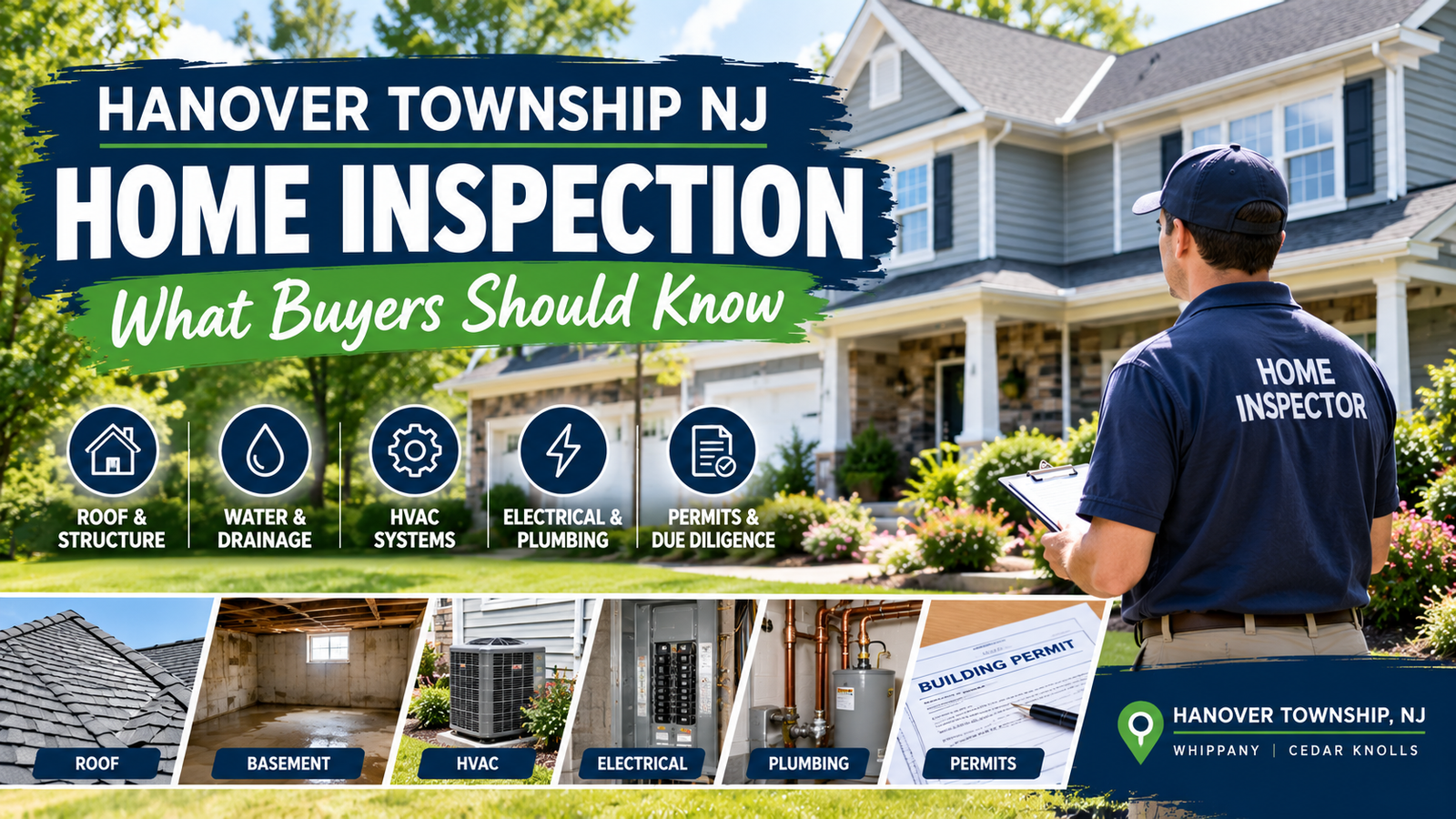
Hanover Township NJ Home Inspection: What Buyers Should Know: A home inspection can help buyers understand the actual condition of a property before closing. In Hanover Township, NJ, buyers should look beyond cosmetic issues and pay particular attention to the roof, foundation, drainage, basement, electrical and plumbing systems, HVAC, permits, renovations, and signs of moisture. A professional inspection can uncover problems that may not be obvious during a showing.
Buying a home in Whippany or Cedar Knolls is a major investment. Even a beautifully maintained property can have hidden issues that are difficult to see during a typical showing.
That is why a Hanover Township home inspection should be an important part of your due-diligence process.
What Is a Home Inspection?
A home inspection is a visual evaluation of a property’s major accessible components and systems.
A qualified home inspector typically evaluates areas such as:
- Foundation and structural components
- Roof and visible roofing components
- Exterior siding and trim
- Windows and doors
- Attic areas
- Basement and crawl spaces
- Electrical systems
- Plumbing
- Heating and cooling systems
- Water heaters
- Interior walls, ceilings, and floors
- Stairs and railings
- Drainage and visible water-related concerns
- Safety-related conditions
The inspection is not designed to guarantee that a house has no problems.
Instead, it helps a buyer understand the property’s current visible condition and identify issues that may require further evaluation.
Should You Get a Home Inspection in Hanover Township?
In most situations, buyers should seriously consider having an independent home inspection.
New Jersey’s Division of Consumer Affairs recommends that buyers have a qualified, independent home inspector evaluate the property soon after the contract becomes binding. The state also recommends that buyers attend the inspection when possible so they can ask questions and better understand the property.
An inspection can be especially valuable when purchasing an older home, a property that has undergone renovations, or a house with a basement, attic, pool, addition, finished lower level, or other significant improvements.
Even a newer home can have construction or maintenance issues.
The important point is this:
A home inspection is not about finding a perfect house. It is about understanding the house you are actually buying.
What Does a Home Inspector Look For?
Every inspection is different, but buyers should expect the inspector to examine the major accessible components of the property.
1. Roof and Attic
Roof problems can become expensive quickly.
During the inspection, the inspector may look for visible signs of:
- Damaged or missing shingles
- Improper flashing
- Roof leaks
- Water staining
- Deteriorated roofing materials
- Poor attic ventilation
- Moisture
- Signs of previous repairs
A roof that looks fine from the driveway may have problems that aren’t visible from the ground.
If the inspector identifies a concern, additional evaluation by a qualified roofing professional may be appropriate.
2. Foundation, Basement and Structure
Basements deserve particular attention when buying a home in Hanover Township.
Your inspector may look for:
- Cracks in foundation walls
- Water intrusion
- Dampness
- Efflorescence
- Signs of previous flooding
- Structural movement
- Improper drainage
- Sump pump problems
- Cracks around windows
- Evidence of repairs
Not every crack means a major structural problem.
However, significant or unusual cracks should not simply be ignored.
If something appears questionable, ask whether a structural engineer or other specialist should evaluate it.
3. Water and Drainage Problems
Water is one of the most important things buyers should investigate.
Look carefully at:
- Basement walls
- Floors
- Foundation areas
- Gutters
- Downspouts
- Grading around the house
- Sump pumps
- Exterior drainage
- Areas around additions and decks
During a showing, a basement may look completely dry.
That does not necessarily mean there has never been water intrusion.
Ask the seller whether there have been previous water problems and carefully review anything disclosed about leaks, flooding, drainage, or waterproofing.
4. Electrical System
Electrical problems can range from relatively minor repairs to significant safety concerns.
An inspector may identify:
- Older electrical components
- Improper wiring
- Missing outlet covers
- GFCI issues
- Improperly installed fixtures
- Overloaded circuits
- Exposed wiring
- Electrical panels requiring further evaluation
If a home has had extensive renovations, make sure you understand whether the work was properly permitted.
5. Plumbing
Plumbing should also receive careful attention.
Potential issues include:
- Leaking pipes
- Low water pressure
- Corrosion
- Drain problems
- Water heater concerns
- Improperly installed plumbing
- Old or deteriorated components
A small visible leak can sometimes indicate a larger problem behind a wall or beneath a fixture.
6. Heating and Air Conditioning
Replacing an HVAC system can be expensive, so buyers should understand the approximate age and condition of major equipment.
Ask the inspector about:
- Furnace or boiler age
- Air-conditioning system age
- Visible leaks
- Unusual noises
- Ductwork
- Ventilation
- Thermostat operation
- Maintenance concerns
- Approximate remaining useful life
An inspection does not necessarily predict exactly when a system will fail.
However, knowing that an HVAC system is older can help you budget for future ownership costs.
7. Finished Basements and Renovated Spaces
Finished basements can add valuable living space, but buyers should look beyond the paint, flooring, and finished walls.
Ask:
- Was the basement professionally finished?
- Were permits required?
- Is there evidence of previous moisture?
- Are electrical modifications visible?
- Are there appropriate exits where required?
- Are finished areas represented accurately?
- Are there signs of water damage behind finished walls?
A beautifully finished basement should still be evaluated as part of the overall property.
Why Permit History Matters in Hanover Township
This is one of the most important Hanover-specific issues buyers should investigate.
The Township of Hanover provides access to property permit history through its SDL portal. Buyers can use permit records to investigate construction and improvement history associated with a property.
This can be particularly useful when a home has:
- A finished basement
- An addition
- A deck
- An in-ground pool
- A renovated kitchen
- A remodeled bathroom
- Electrical upgrades
- Plumbing work
- A converted garage
- A new HVAC system
- Structural modifications
A home inspection and a permit-history search serve different purposes.
The inspector evaluates the physical condition of the property.
Permit records can help you understand whether certain improvements went through the appropriate municipal process.
You should consider doing both.
Home Inspection vs. Hanover Township Municipal Inspection
These are not the same thing.
A private home inspection is performed for the buyer and is intended to help the buyer understand the condition of the property.
Municipal inspections and certificates address specific code, safety, zoning, construction, or occupancy requirements.
For example, Hanover Township’s current procedures include municipal inspections and documentation related to resale properties and fire/life-safety requirements.
That does not mean a municipal inspection replaces your private home inspection.
A municipal inspection may focus on specific requirements.
A private inspection is much broader and is intended to help you understand the condition of the home you are considering purchasing.
What About Older Homes in Whippany and Cedar Knolls?
Older homes can offer character, established neighborhoods, larger lots, and mature landscaping.
They can also require additional due diligence.
Depending on the property’s age, buyers may want to investigate:
- Roof age
- Electrical service and wiring
- Plumbing materials
- Heating systems
- Windows
- Insulation
- Foundation condition
- Drainage
- Sewer or septic considerations, where applicable
- Lead-based paint
- Radon
- Previous additions or renovations
- Permit history
Homes built before 1978 also require particular attention to lead-based paint disclosures under federal requirements.
Your inspector can help identify conditions that deserve further investigation, but specialized testing may be necessary for issues such as radon, mold, lead, or underground oil tanks.
Should Buyers Test for Radon?
Radon is a naturally occurring radioactive gas that can accumulate inside buildings.
Because it is colorless and odorless, you cannot determine whether a home has elevated radon simply by looking at it.
New Jersey consumer guidance recommends discussing radon with your independent home inspector and determining whether testing is appropriate.
Depending on the property and transaction, buyers may choose to conduct a separate radon test.
If you are purchasing a home with a basement or lower-level living area, ask your real estate professional and inspector whether radon testing should be part of your due diligence.
What If the Home Inspection Finds Problems?
Don’t panic.
Almost every inspection report contains items that need attention.
The key is determining which findings are:
Minor maintenance items
Examples:
- Loose fixtures
- Minor caulking
- Small cosmetic defects
- Missing hardware
- Minor drainage adjustments
Significant repairs
Examples:
- Roof deterioration
- Plumbing leaks
- HVAC problems
- Electrical deficiencies
- Significant water intrusion
- Structural concerns
Items requiring specialist evaluation
Examples:
- Suspected structural movement
- Extensive mold
- Underground tanks
- Major electrical concerns
- Sewer problems
- Significant foundation issues
The inspection report should be reviewed carefully with your real estate professional and, when appropriate, qualified contractors or specialists.
Can a Buyer Ask the Seller to Make Repairs?
Potentially, depending on the contract and circumstances of the transaction.
An inspection does not automatically mean that the seller must fix every item identified by the inspector.
The parties may negotiate based on the inspection findings, contract terms, the condition of the property, and the circumstances of the transaction.
Possible outcomes can include:
- Seller completes a repair
- Seller provides a credit
- Buyer accepts the condition
- Buyer and seller negotiate another solution
- Specialist evaluation is obtained
Your attorney and real estate professional can explain how the inspection provisions in your particular contract apply.
What Should Hanover Township Buyers Check Before Closing?
A home inspection should be only one part of your due diligence.
Before closing, consider reviewing:
Property condition
☐ Home inspection report
☐ Roof condition
☐ HVAC systems
☐ Plumbing
☐ Electrical
☐ Foundation
☐ Basement/crawl space
☐ Drainage and water history
☐ Appliances included in the sale
Property records
☐ Permit history
☐ Renovations and additions
☐ Finished basement
☐ Deck or patio
☐ Pool
☐ Major electrical/plumbing work
☐ Zoning considerations
Environmental considerations
☐ Radon testing
☐ Lead-based paint considerations
☐ Mold/moisture concerns
☐ Underground oil tank, if applicable
Financial considerations
☐ Estimated repair costs
☐ Future maintenance
☐ Property taxes
☐ Homeowners insurance
☐ Utility costs
☐ Potential major replacement costs
What Should You Ask the Home Inspector?
Don’t be afraid to ask questions during the inspection.
Some useful questions include:
How old is the roof?
How old are the HVAC systems?
Do you see evidence of previous water intrusion?
Are there structural concerns?
Does anything require immediate attention?
What should I budget for within the next few years?
Are there items that require a specialist?
Do you see evidence of previous repairs?
Are there safety issues I should understand?
Is there anything you would investigate further before I close?
The goal isn’t to memorize every technical detail in the inspection report.
The goal is to understand the property’s biggest risks and likely maintenance needs.
How Long Does a Home Inspection Take?
The length of an inspection depends on the size, age, condition, and complexity of the property.
A larger home with an attic, basement, crawl space, multiple HVAC systems, pool, additions, or extensive renovations may require more time than a smaller property.
Whenever possible, buyers should attend at least part of the inspection.
Seeing the property with the inspector can make the written report much easier to understand.
Should You Skip the Inspection in a Competitive Market?
This is a question buyers sometimes face when competing for a desirable home.
However, removing or weakening inspection protections can involve significant financial risk.
Before making that decision, understand exactly what you are giving up and discuss the implications with your real estate attorney and agent.
A competitive market does not change the physical condition of the house.
A roof still has a useful life.
A foundation can still have problems.
A basement can still have water intrusion.
Electrical systems can still need repairs.
The right strategy depends on the property, your financial position, the contract, and the specific market circumstances.
Hanover Township Home Inspection Checklist
Hanover Township Home Inspection Checklist
Before moving forward with a property, use this checklist to make sure the major inspection and due-diligence items have been addressed:
| ✓ | What to Check | Why It Matters |
|---|---|---|
| ☐ | Schedule an independent home inspection | Gives you a professional assessment of the property’s condition. |
| ☐ | Review the complete inspection report | Helps you understand defects, maintenance needs, and recommended follow-up. |
| ☐ | Identify major concerns | Determines which issues may require immediate attention or further evaluation. |
| ☐ | Arrange specialist evaluations when needed | Structural, electrical, plumbing, roofing, or other concerns may require a qualified specialist. |
| ☐ | Check the property’s permit history | Helps verify the history of additions, renovations, and other permitted work. |
| ☐ | Confirm additions and renovations are documented | Important for finished basements, additions, decks, pools, and major remodeling. |
| ☐ | Consider radon testing | Testing can identify elevated radon levels that cannot be detected through a visual inspection. |
| ☐ | Look for moisture and drainage problems | Water intrusion can lead to costly repairs and should be investigated before closing. |
| ☐ | Review the age of the roof and HVAC systems | Older major systems may require replacement or significant maintenance in the future. |
| ☐ | Estimate potential near-term repairs | Helps you budget for expenses after purchasing the home. |
| ☐ | Discuss important findings with your real estate professional | Your agent can help you understand the transaction and negotiation considerations. |
| ☐ | Consult your attorney about contract provisions | Legal questions about inspections, negotiations, and contract rights should be addressed by your attorney. |
Frequently Asked Questions About Hanover Township Home Inspections
Is a home inspection required when buying a house in Hanover Township?
A private home inspection is not the same as a municipal inspection or certificate. Buyers should discuss inspection requirements and contract provisions with their attorney and real estate professional. An independent inspection is strongly recommended as part of buyer due diligence.
How much does a home inspection cost in Hanover Township NJ?
Inspection costs vary based on the inspector, property size, age, location, and additional services or testing requested. Buyers should obtain pricing directly from qualified inspectors.
What does a home inspection cover?
A typical inspection evaluates accessible major components such as the roof, structure, exterior, plumbing, electrical, heating and cooling systems, interior areas, attic, basement, and other visible components. Specialized testing may be separate.
Should I get a home inspection on an older Hanover Township house?
Yes, an inspection can be particularly useful for older properties because buyers may need to understand the condition and age of major systems, previous renovations, electrical and plumbing components, roofing, foundation, and other areas.
Should I check permits before buying a home in Hanover Township?
Yes. Permit history can provide useful information about previous construction and improvements. Hanover Township provides access to property permit history through its SDL portal.
Does a home inspection check for mold?
A general home inspection may identify visible signs of moisture or conditions that could contribute to mold, but specialized mold testing may be necessary when there is a specific concern.
Should I test for radon?
Radon testing may be appropriate depending on the property and circumstances. Discuss it with your inspector and real estate professional.
What happens if the inspection finds a major problem?
The buyer and seller may have several options depending on the contract and circumstances, including requesting repairs, negotiating a credit, obtaining additional evaluations, accepting the condition, or pursuing another negotiated solution.
Can a home inspection tell me how much repairs will cost?
An inspector can identify conditions that may require repair, but inspectors generally do not provide contractor-level estimates for every repair. Significant issues should be evaluated by appropriate licensed professionals.
Final Thoughts: Don’t Just Fall in Love With the House—Inspect It
Buying a home in Hanover Township, NJ is about more than finding the right number of bedrooms, the right neighborhood, or a beautiful kitchen.
You are also buying the property’s roof, foundation, plumbing, electrical system, HVAC equipment, drainage, basement, renovations, and maintenance history.
That’s why a thorough inspection and careful due diligence can be so valuable.
Before purchasing a home in Whippany or Cedar Knolls, take the time to understand:
- The home’s physical condition
- The age of its major systems
- Any visible water or structural concerns
- Previous renovations
- Permit history
- Potential environmental concerns
- Likely near-term maintenance costs
The goal isn’t to find a house with absolutely nothing wrong with it.
The goal is to know what you’re buying—and make an informed decision before you close.
If you’re considering buying a home in Hanover Township, Whippany, or Cedar Knolls, the HOMEGROWN Hanover Team can help you navigate the buying process, understand property-specific considerations, and connect you with the appropriate professionals for inspections and due diligence.