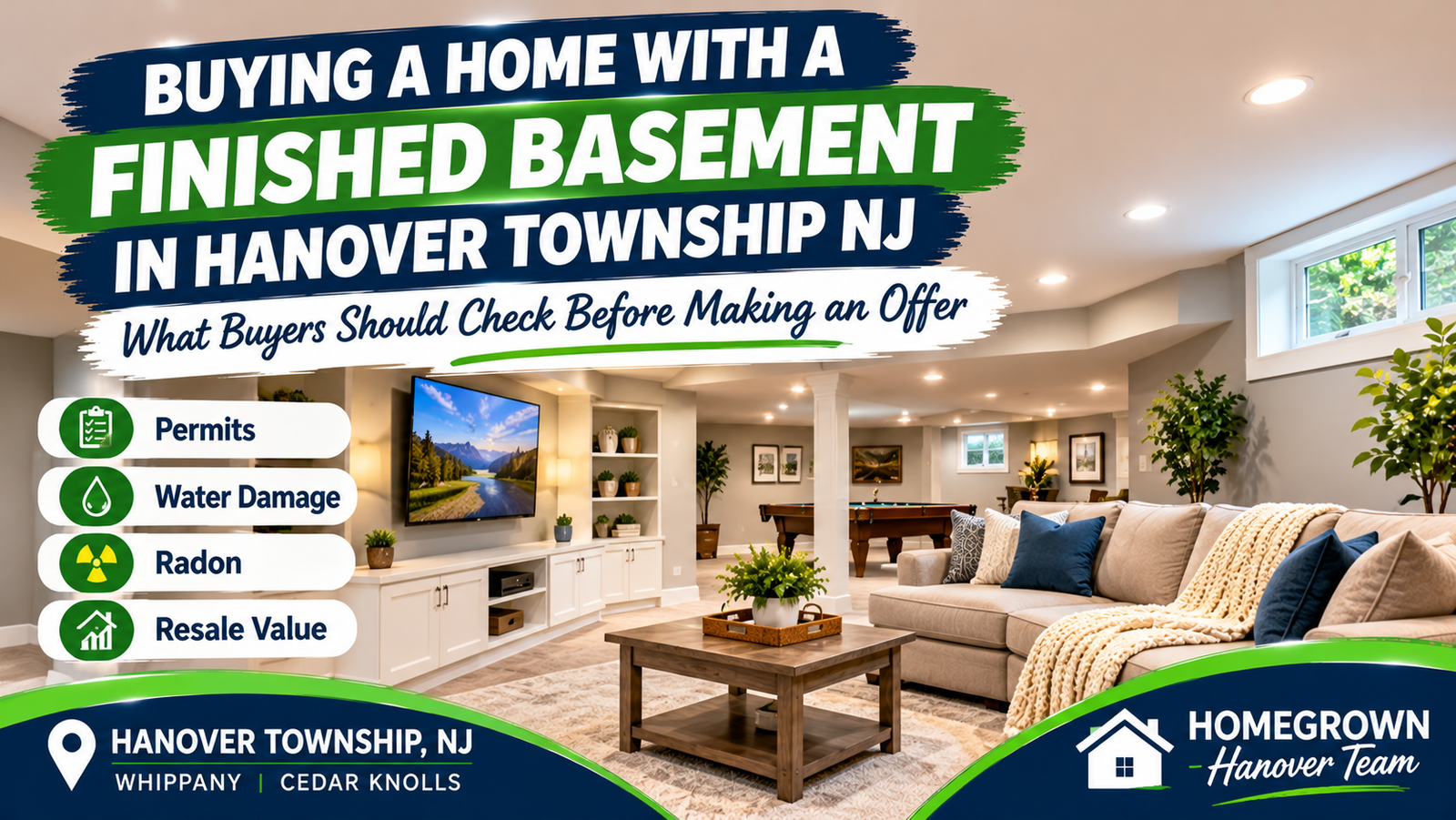
A finished basement can be one of the most attractive features when buying a home in Hanover Township, New Jersey. Whether you’re looking for a home office, entertainment room, workout area, or additional space for everyday living, a finished basement can make a property feel more spacious and functional.
However, buying a home with a finished basement in Hanover Township NJ requires more than checking the flooring, lighting, and overall appearance.
Before purchasing, homebuyers should investigate whether the basement was properly permitted, whether there are signs of moisture or flooding, and whether the space meets applicable building and safety requirements.
Additionally, this is particularly important when comparing older homes in Whippany and Cedar Knolls, where basement conditions and renovation histories can vary significantly.
In this guide, we’ll explain what to look for, which questions to ask, and how to determine whether a finished basement is a valuable feature or a potential source of unexpected expenses.
Is Buying a Home With a Finished Basement in Hanover Township NJ a Good Idea?
Yes, a finished basement can be a valuable addition to a home when it is properly constructed, dry, safe, and suitable for its intended use.
For example, many buyers appreciate the flexibility of having additional space without needing to build an extension.
A finished basement may be used as:
- A home office for remote or hybrid work
- A family entertainment room
- A home gym or exercise area
- A playroom or hobby space
- A media or gaming room
- An additional gathering area
However, not every finished basement offers the same value.
A basement with documented permits, appropriate ventilation, reliable waterproofing, and quality workmanship may be more appealing than one with unresolved moisture problems or unverified renovations.
Therefore, the key is understanding exactly what you’re purchasing.
1. Verify That the Finished Basement Was Properly Permitted
First, one of the most important questions to ask is whether the basement renovation was completed with the necessary permits and inspections.
In Hanover Township, building work may require permits for construction, electrical, plumbing, and other regulated improvements.
For example, finishing a basement may involve installing new walls, electrical outlets, lighting, heating systems, or a bathroom.
Consequently, these improvements may require municipal review.
Why Basement Permits Matter
Proper permits help establish that regulated work was reviewed under applicable construction requirements.
In contrast, an unpermitted basement can create potential complications involving:
- Building code compliance
- Electrical and plumbing safety
- Future renovations
- Insurance questions
- Property resale
- Unexpected correction costs
Furthermore, a basement that looks professionally finished is not necessarily a legally approved living space.
How to Check Basement Permits in Hanover Township
Start by asking the seller for copies of construction permits, inspection approvals, and applicable certificates.
Next, contact the Hanover Township Building & Zoning Department or research available permit history through the township’s SDL portal.
Official resource: Hanover Township Building & Zoning Department
If permits cannot be located, ask the municipality what records or inspections are needed to determine the basement’s status.
For additional guidance on evaluating renovations and older properties, read Buying an Older Home in Hanover Township NJ: What to Check.
2. Check for Basement Water Damage and Moisture Problems
Next, water intrusion is one of the most important concerns when purchasing a home with a finished basement.
Because basements are located partly or entirely below ground level, they are more vulnerable to groundwater, surface runoff, and moisture entering through foundations.
Moreover, even a beautifully renovated basement can conceal water damage behind drywall, carpeting, or finished flooring.
Warning Signs of Basement Moisture
During your home tour and inspection, look for:
- Musty or damp odors
- Water stains on walls or flooring
- Peeling paint or bubbling finishes
- Warped baseboards
- Discolored carpeting
- Visible mold-like growth
- White powdery deposits on masonry
- Rust on metal components
- Cracks in foundation walls
- Evidence of previous water repairs
For example, a recently painted basement is not automatically a problem. However, buyers should ask whether the work was cosmetic or related to previous moisture issues.
Questions to Ask the Seller
Before making an offer, consider asking:
- Has the basement ever flooded?
- Has water entered during heavy rainfall?
- Was a waterproofing system installed?
- Has the basement experienced sewer backups?
- Were any walls or floors replaced because of water damage?
- Are there warranties or invoices for previous repairs?
Additionally, the seller’s disclosures should be reviewed alongside inspection findings and other available evidence.
For more information about identifying potential problems in established properties, see Buying an Older Home in Hanover Township NJ: What to Check.
3. Understand Flood Zones in Hanover Township NJ
Hanover Township includes waterways and environmentally sensitive areas associated with the Whippany River and its tributaries.
Therefore, buyers should investigate the specific address rather than assuming all homes in a neighborhood face the same flood risk.
A finished basement may be especially vulnerable to flood-related damage because flooring, drywall, furniture, and electrical systems can be located below ground level.
How to Check a Property’s Flood Risk
First, visit the FEMA Flood Map Service Center.
Next, review New Jersey’s flood-risk resources and ask about any previous flooding or water intrusion.
However, remember that a home outside a FEMA high-risk flood zone may still experience basement water problems from heavy rainfall, groundwater, or poor drainage.
Does Homeowners Insurance Cover Basement Flooding?
Standard homeowners insurance generally does not cover damage caused by flooding.
Instead, flood insurance is typically purchased separately. Furthermore, coverage for finished basement improvements and personal belongings may be limited.
Therefore, before purchasing, ask your insurance provider what would and would not be covered.
For a more detailed explanation, read What to Know About Flood Zones in Hanover Township NJ Before Buying.
4. Inspect the Foundation Before Falling in Love With the Finished Space
Although a finished basement may look attractive, it can hide portions of the home’s foundation.
For instance, drywall, insulation, built-in cabinets, and decorative wall panels can make it difficult to see cracks or signs of structural movement.
As a result, professional home inspections are particularly important when evaluating finished basements.
What Inspectors May Look For
A qualified inspector may evaluate visible areas for:
- Foundation cracks
- Signs of settlement
- Water penetration
- Uneven flooring
- Deteriorating structural components
- Improper repairs
- Moisture accumulation
If the inspector identifies concerning conditions, a structural engineer or waterproofing specialist may be needed.
However, a standard home inspection cannot guarantee that concealed areas are free from defects.
Additionally, ask whether any foundation repairs were completed and request available engineering reports, invoices, and warranties.
For more information, read Hanover Township NJ Home Inspection: What Buyers Should Know.
5. Check Ceiling Height, Stairways, and Emergency Exits
Although a finished basement may look like an ordinary living room, below-grade spaces have specific safety considerations.
For example, ceiling height, stair dimensions, emergency escape openings, smoke alarms, and other requirements depend on the applicable construction code and the space’s approved use.
Why Ceiling Height Matters
Low ceilings can make a basement feel cramped and may affect whether the space meets applicable code requirements.
Additionally, ductwork, beams, and plumbing may reduce clearance in certain areas.
Therefore, do not assume that an attractive ceiling finish means the height is compliant.
Check Emergency Escape Requirements
Basements used for sleeping may require emergency escape and rescue openings, subject to the applicable code and exceptions.
These openings are intended to provide a means of escape or rescue during an emergency.
Consequently, buyers should ask the township’s construction official whether the existing basement configuration and intended use meet applicable requirements.
Inspect Basement Stairs
Pay attention to:
- Stair width and clearance
- Handrails
- Lighting
- Uneven steps
- Headroom
- Door placement
Furthermore, a safe and functional staircase is especially important when the basement is used frequently.
6. Can a Finished Basement Be Used as a Bedroom in Hanover Township NJ?
Not automatically.
Although a room may contain a bed, that does not necessarily mean it qualifies as a legal bedroom.
Instead, whether a basement bedroom is permitted depends on applicable building codes, approved plans, emergency escape provisions, and other safety requirements.
Therefore, before treating a finished basement room as an additional bedroom, verify its approved status.
What About a Basement Apartment?
A basement apartment or separate rental unit raises additional zoning, building, fire safety, and occupancy questions.
For example, a basement containing a bathroom, kitchenette, and separate entrance is not automatically approved as a rental apartment.
Consequently, if rental income is part of your purchasing plan, confirm the property’s permitted use with Hanover Township before relying on that income.
7. Test for Radon Before Buying
Radon is a naturally occurring radioactive gas that can enter homes through foundations and openings in the ground.
Because it cannot be seen or smelled, testing is the only reliable way to determine whether elevated levels are present.
Furthermore, the New Jersey Department of Environmental Protection recommends testing homes for radon, noting that levels can vary significantly even within the same neighborhood.
Why Finished Basements Deserve Attention
Radon concentrations may be elevated in lower levels of a home because they are closer to the ground.
Therefore, if you plan to use the basement regularly, testing is especially important.
For a buyer’s real estate transaction, New Jersey requires radon testing to be performed by a certified professional.
Fortunately, if elevated radon is found, mitigation systems can often reduce concentrations effectively.
Official resource: NJDEP Radon Testing Information
8. Evaluate Basement Heating, Cooling, and Ventilation
A basement should feel comfortable throughout the year, not just during the season when you tour the home.
However, basements may be cooler in winter, humid in summer, or poorly ventilated.
What Buyers Should Check
Ask whether the finished basement has:
- Adequate heating
- Appropriate cooling
- Proper ventilation
- Humidity control
- Insulation
- Functional electrical outlets
- Sufficient lighting
If the basement was finished after the original home was built, verify whether the heating and cooling systems were designed or modified to serve the additional space.
Additionally, a portable heater or dehumidifier may help with comfort, but it does not automatically resolve underlying building or moisture problems.
9. Inspect Basement Bathrooms and Plumbing
A finished basement with a bathroom can be convenient for guests and everyday use.
However, below-grade plumbing may require specialized equipment, depending on the home’s sewer configuration.
Important Plumbing Questions
Ask:
- Was the bathroom properly permitted?
- Does it use a sewage ejector pump?
- Has the pump been serviced?
- Are there signs of leaks?
- Does the toilet flush properly?
- Is there adequate ventilation?
- Have there been sewer backups?
If the bathroom uses an ejector system, learn about its maintenance requirements and potential replacement costs.
Furthermore, a licensed plumber can evaluate concerns identified during the inspection.
10. Does a Finished Basement Count Toward a Home’s Square Footage?
This is one of the most important questions when comparing homes.
Although a finished basement may add useful living space, it is not necessarily included in the home’s above-grade living area.
Instead, appraisers and real estate professionals generally distinguish between above-grade and below-grade areas.
Even a fully finished walkout basement may be reported separately under applicable appraisal standards.
Why Square Footage Matters
For example, imagine comparing two homes:
| Feature | Home A | Home B |
|---|---|---|
| Above-grade living area | 2,000 sq. ft. | 2,000 sq. ft. |
| Finished basement | 800 sq. ft. | None |
| Total usable finished space | Potentially 2,800 sq. ft. | 2,000 sq. ft. |
| Appraisal treatment | Basement generally evaluated separately | Above-grade area only |
Although Home A may offer more usable space, that does not mean it should automatically be valued as a 2,800-square-foot above-grade home.
Therefore, when reviewing listings, ask whether the advertised square footage includes below-grade areas.
11. How Much Value Does a Finished Basement Add?
A finished basement can improve a property’s appeal. However, there is no universal amount it adds to resale value.
Instead, its contribution depends on factors such as:
- Quality of construction
- Condition and moisture history
- Permits and approvals
- Ceiling height
- Natural light
- Bathroom availability
- Accessibility
- Intended use
- Local buyer demand
For example, a dry, professionally finished basement with a functional layout may be attractive to buyers looking for a home office or entertainment area.
In contrast, a basement with water damage or unverified renovations may have less appeal.
Compare Similar Hanover Township Homes
When evaluating a finished basement, review comparable sales in Whippany and Cedar Knolls.
Ideally, compare homes with similar above-grade square footage, property condition, location, and basement features.
Additionally, a local real estate professional can help you understand how buyers have responded to similar properties.
12. What Are the Ongoing Costs of Maintaining a Finished Basement?
Although a finished basement provides additional usable space, it may also involve extra maintenance costs.
For example, potential expenses include:
- Dehumidifier operation
- Sump pump maintenance
- Waterproofing repairs
- HVAC servicing
- Plumbing maintenance
- Flooring replacement
- Mold remediation when necessary
- Insurance premiums
If the basement has a sump pump, ask whether it has a battery backup and how the system performs during power outages.
Furthermore, buyers should consider these costs when estimating the total expense of homeownership.
For a broader breakdown of purchasing and ownership expenses, read Hanover Township NJ Home Buying Costs: Closing Costs, Taxes & More.
13. Questions to Ask Before Making an Offer
Before purchasing a home with a finished basement in Hanover Township NJ, ask the seller or listing agent the following questions:
- When was the basement finished?
- Were permits obtained and final inspections completed?
- Has the basement ever flooded or experienced water intrusion?
- Are there waterproofing warranties or repair records?
- Has the property been tested for radon?
- Are any basement rooms approved for sleeping?
- Is the finished basement included in the advertised square footage?
- Have electrical, plumbing, or HVAC systems been modified?
- Are there any known foundation problems?
- What maintenance has been performed on the sump pump or drainage system?
- Are there insurance claims related to basement water damage?
- Does the basement’s intended use comply with municipal requirements?
Once you’ve gathered this information, review any concerns with your home inspector, attorney, or other qualified professionals.
Additionally, understanding potential repair costs can help you decide whether to negotiate repairs, request credits, or adjust your offer.
For more advice about preparing a strong purchase offer, see How to Make a Competitive Offer on a Hanover Township NJ Home.
Finished Basement Home Buying Checklist
Before finalizing your purchase, use this checklist to evaluate the property.
| Item to Verify | Why It Matters |
|---|---|
| Construction permits | Helps establish whether regulated renovations were approved |
| Final inspection records | Confirms the status of required municipal inspections |
| Foundation condition | Identifies visible structural concerns |
| Water intrusion history | Helps assess potential moisture problems |
| Flood zone | Informs insurance and risk considerations |
| Radon testing | Identifies elevated radon concentrations |
| Emergency exits | Important for safety and approved sleeping areas |
| Electrical systems | Helps identify unsafe or outdated work |
| Plumbing | Important when bathrooms or wet bars are installed |
| HVAC and ventilation | Supports comfort and humidity control |
| Square footage | Helps avoid misleading home comparisons |
| Comparable sales | Helps evaluate the property’s asking price |
Ultimately, completing these checks can help you identify potential concerns before they become expensive surprises.
Frequently Asked Questions About Buying a Home With a Finished Basement in Hanover Township NJ
Is a finished basement worth it when buying a home in Hanover Township NJ?
Yes, a finished basement can be worthwhile if it provides useful additional space and is properly constructed, dry, and safe. However, buyers should verify permits, inspections, moisture conditions, and the property’s asking price before making a decision.
Do finished basements need permits in Hanover Township NJ?
Basement finishing work may require building, electrical, plumbing, or other permits depending on the project. Therefore, buyers should verify the renovation history with the Hanover Township Building & Zoning Department.
Can I use a finished basement as a bedroom?
Only if the room meets applicable building and safety requirements and is approved for that use. In other words, a finished room does not automatically qualify as a legal bedroom.
Are finished basements included in square footage?
Finished below-grade areas are generally reported separately from above-grade living area in appraisals. Therefore, buyers should confirm how square footage is represented in the listing and appraisal.
Should I test for radon in a finished basement?
Yes. New Jersey recommends radon testing because elevated levels can occur in homes throughout the state. Furthermore, testing is particularly relevant when the basement will be used regularly.
Does a finished basement increase home value?
A finished basement may increase a home’s market appeal and value. However, the amount depends on quality, condition, legal status, functionality, and comparable local sales.
What if the finished basement was built without permits?
First, ask the township about the property’s permit history. Next, determine what steps may be necessary to address unpermitted work. Finally, consult your attorney and appropriate inspectors before deciding how to proceed.
Can a finished basement flood even if the home is not in a flood zone?
Yes. For example, basement water intrusion can occur because of heavy rain, groundwater, drainage problems, plumbing failures, or sewer backups, even outside mapped high-risk flood zones.
Final Thoughts: Buying a Home With a Finished Basement in Hanover Township NJ
A finished basement can make a Hanover Township home more versatile and appealing, especially for buyers who want additional space for working, entertaining, exercising, or relaxing.
However, the quality and condition of the space matter far more than attractive finishes.
Therefore, before buying, verify the basement’s permits, inspect for water damage, test for radon, review safety requirements, and understand how the space contributes to the home’s overall value.
Additionally, whether you’re searching in Whippany or Cedar Knolls, taking these precautions can help you avoid unexpected expenses and make a more confident purchasing decision.
The HOMEGROWN Hanover Team of Fathom Realty helps buyers evaluate homes throughout Hanover Township and surrounding Morris County communities.
From comparing finished basements to reviewing local market conditions and negotiating offers, our team can help you identify properties that fit your lifestyle and budget.
Ready to find a home with a finished basement in Hanover Township NJ? Contact the HOMEGROWN Hanover Team to explore available homes in Whippany and Cedar Knolls.
Disclaimer: This article provides general real estate information and is not a substitute for professional building inspections, legal advice, engineering evaluations, or municipal permit verification. Requirements vary by property, renovation date, and intended use.